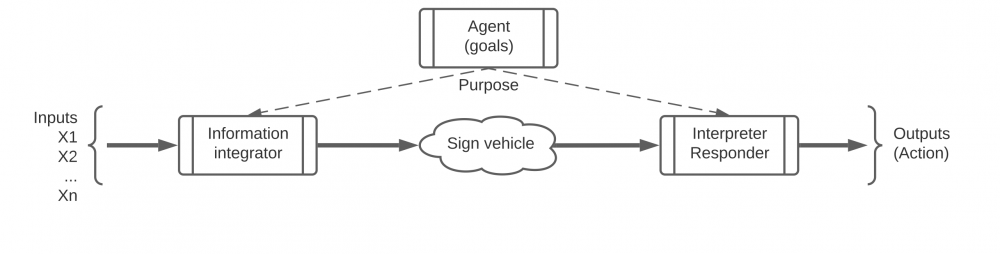
We said earlier that all matter carries mutual information. So a physical system x that exists now may have mutual information with respect to a physical system that existed in the past, also exists now, and/or will exist in the future. This mutual information is an affordance which can be used by a system to gain value, i.e., move the environment towards a goal state, i.e., serve a purpose. A separate system Z can thus respond in effect to system y (which is distant in time and/or space) by responding in fact to system x.
So, for example, a bacterial food source may generate particular sugar molecules which diffuse away from the source. (The source “causes” sugar molecules which float away). If a bacterium has a mechanism to move to toward this source it will improve its chances of survival. Given that the sugar molecules have mutual information with respect to the source, by utilizing a mechanism that responds to the sugar molecule, the bacterium can achieve it’s goal,of moving closer to the food source.
So we can say mutual information is an affordance for meaning. The *meaning* of the information is determined by the mechanism which generates the response (output) to the information in the input. We say that the meaning is generated by the mechanism which interprets the input by generating an output specific to that input. This output constitutes the “meaning” associated with the interpreting mechanism.
Note that the same system X with mutual information(MI) with respect to Y can have different meanings to different responding systems, depending on the specific responses. To a system that responds to X by moving closer to Y, the “meaning” of X is “move closer to Y”. A different system may respond to X by moving farther from Y, in which case the “meaning” of X is “move farther from Y”. It is also true that the same system X can have different mutual information with respect to different responding systems. X may have significant MI (mutual information) w/ respect to Y, but also have similar MI with respect to Z. For example, if I am in a small Japanese village and see a handwritten sign saying “Come in for the best food for miles around!”, I can respond to the mutual information this sign has with restaurants (if I’m hungry), but I can also respond to the mutual information this sign has with native English speakers (if I’m in need of someone who speaks English). So the “meaning” of X depends on the specific response and the system which that response “cares” about.
 Psychule Theory