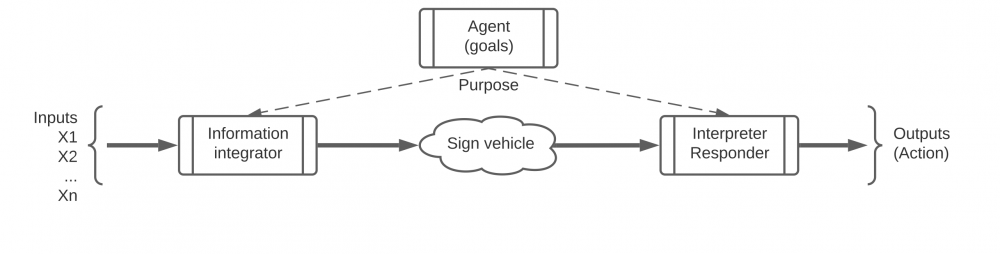
First, a quick primer on Charles Peirce’s semiotics. For Peirce, a “sign” is a process which has 3 main components: 1. the object, 2. the sign vehicle, and 3. the interpretant. These correspond pretty much exactly with the elements of “meaning” described above. Specifically, the “object” is what we called system Y, the sign vehicle is what we called system X, and the interpretant is the specific response to X. It will be more intuitive to describe representation using Peirce’s terminology.
The term “representation”, like function, is frequently used in two related but different senses. Sometimes it refers to the physical thing, or sign vehicle, which does the representing, as in “a stop sign is a representation”. Sometimes the term refers to the act or process of representing, in which case there needs to be someone or something interpreting the representing object. The distinction is significant because the question arises in philosophy as what counts as a representation. If you put information on a disk and shoot that into space (as has happened), does that disk count as a representation, assuming there is in fact no intelligent life out there, and so no one for the disk to represent “to”?
For our purposes we will say representation is the act of representing, and that a vehicle designed for the purpose of representing is an affordance of representation, and that representation happens when said vehicle is used/perceived as a representing vehicle.
To express this in the current framework we have to describe two separate processes (tasks). The first task is the process of creating the representing vehicle, which is the output of the task. This vehicle will have mutual information as determined by the computational functions inherent in the creating mechanism and its inputs. We call this vehicle a representing vehicle if the sole purpose of the vehicle-creating mechanism is to generate a vehicle that carries that mutual information to be used in representation.
The second process involved in the “representation” is the one which takes the representing vehicle as input and generates some output which is valuable relative to the mutual information associated with the vehicle. We would call this an interpretation of the representation. Remember that there could be multiple processes which respond to the same vehicle. The “meaning” of the representation is determined by the mechanism which is doing the interpretation.
For what it’s worth, this two step process is what I call the Psychule. My claim is that this process is the common denominator of any good theory of consciousness. This process explains the “aboutness” (via mutual information) of experience. I claim that all currently popular theories of consciousness (with the exception of panpsychism) will necessarily include such processes. And as for panpsychism, the Psychule theory is a panprotopsychist theory, in that all matter has the fundamental property of mutual information simply by adhering to the laws of physics, and this property is the affordance of consciousness via the psychule.
 Psychule Theory