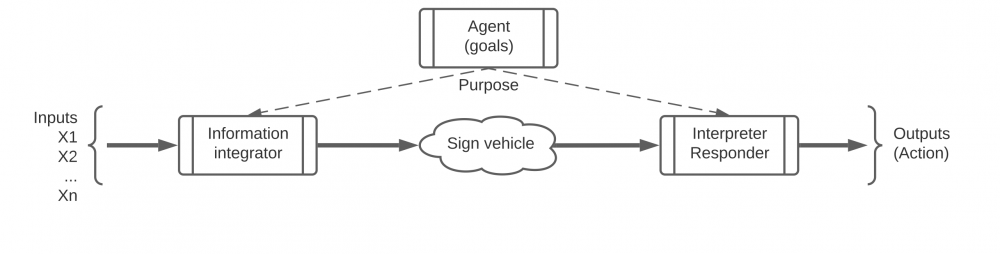
[This is a work in progress. The following is my current understanding as of 2/25/2026, current changes including applying the term “psychule” to the apparatus as opposed to the process, and considering the possibility of panpsychism assuming pattern realization = “experience”]
“Consciousness” is a fuzzy term with multiple definitions. The answer to the question “Is X conscious?”, assuming X is a well delineated physical object or collection of objects, is always “Yes and No”. Always. There will always be at least one reasonable, non-trivial definition where the answer is yes, even if X is a rock. (See below). The question, then, is whether there is a minimal description of the basis of consciousness which applies to all of these definitions. I claim Psychule theory constitutes such a description.
Psychule theory is a materialist, physicalist, computational functionalist, panprotopsychist (and possibly panpsychist) theory and a “minimal unifying model”(“MUM'” https://academic.oup.com/nc/article/2020/1/niaa013/5870169). Psychule theory says the fundamental basis of consciousness is pattern recognition. Note: this theory is using a very specific understanding of “pattern recognition” to which I apply the term psychule. I’m not saying everyone should start using this as a definition of pattern recognition. I’m saying that, when discussing Psychule theory, this definition of “pattern recognition” is the one I’m using. Also note that I am not saying “Consciousness is psychules.” I am saying that any good (useful) theory of consciousness is based on psychules. Ok … for my own definition of consciousness I say psychules are sufficient and necessary, but others might require something extra, like predictive coding, global broadcast, higher order recognition, some sort of valence aka “feeling”, or learning. And some theories, specifically panpsychic theories, actually require slightly less. I’ll (very briefly) discuss how these theories relate to psychules at the end of this page.
Minimal Unifying Model
Psychule theory says the psychule is the minimal unit of a conscious entity just as the molecule (eg., H2O) is the minimal unit of a substance (eg., water). The psychule is a physical structure which performs a specific process: a pattern recognition. (Note: this is a recent [Feb. 2026] change to the terminology whereas I previously referred to the Psychule as the process itself.) More precisely, a psychule performs a specific kind of pattern recognition: the communication of a pattern realization. This is necessarily a 2-step process: the 1st step = a pattern realization and the 2nd step = an interpretation of that realization. So what’s a pattern realization? Every physical interaction is a “pattern realization” in that it involves a measurable physical change, and that change follows a pattern, namely the laws of physics. We identify physical things (say, ducks) by their patterns of interaction (looks like a duck, walks like a duck, sounds like a duck). These patterns in real physical things are thus “real patterns”. (Yes, this is an intentional reference to Dennett’s “Real Patterns”: https://ruccs.rutgers.edu/images/personal-zenon-pylyshyn/class-info/FP2012/FP2012_readings/Dennett_RealPatterns.pdf)
In order to understand this type of pattern recognition, aka the psychule, you must have a particular understanding of information, goals, communication, and meaning:
Information
Every physical interaction generates mutual information. Given the interaction
A—>[B]—>C
(“A interacts w/ B to generate C”, brackets represent a mechanism as explained below),
and because the interaction follows physical laws, C bears mutual information with respect to both A and B. Measuring “C” can tell us something about what we would get if we measured A and/or B (in the past or possibly the future).
Goals
Mutual information is an affordance for a system with a goal. A system has a goal, by definition here, if there is a state of the world such that the system can determine a discrepancy between the current state and the goal state and in response initiate action which will tend to move the world toward the goal state. Thus, any system with an attractor state, including living (autopoetic) systems, counts as having a goal here.
Communication
If a system with a goal might better achieve its goal by responding in a certain way to “A”, the system might be able to further this goal by generating a mechanism “B” that responds to “A” by producing “C”. It might be the case that C by itself is sufficient to help achieve the goal. This would then be a cybernetic mechanism, such as a Watt governor or analog thermostat. However, the action needed to achieve the goal might be at some distance from the mechanism realizing “A”. C must then be communicated to a 2nd mechanism, “D”, which produces E, wherein E is the mechanism which tends to achieve the goal.
A—>[B]—>C—>[D]—>E
This is the psychule.
Meaning
The mechanisms B and D must be selected/coordinated. C’s purpose is to carry the mutual information with respect to “A”. The mechanisms B and D are multiply realizable, as is the information vehicle C. The system could instead respond to “A” by organizing a mechanism [Q] which produces “X”. As long as the system coordinates the realizer, B or Q, with the interpreter D, whether the information vehicle is C or X doesn’t matter. In Charles Peirce’s terminology, C is a symbolic sign vehicle. (https://plato.stanford.edu/entries/peirce-semiotics/)
So how does all this relate to consciousness-type ideas like “aboutness”, “qualia”, and “meaning”? “Aboutness” is a reference to the relevant mutual information carried by C, the sign vehicle. “Qualia” is a reference to the pattern recognized: “A”. “Meaning” is determined by the result “E”. To this system, “A” means “do E”. (See https://philpapers.org/rec/HAIHSI for Dennett’s and Haig’s version of this.)
Evolution: bacteria to human
The first psychules were probably associated with cell-surface receptors in single cell organisms. The canonical example is chemotaxis in some bacteria. A receptor (B) realizes a molecule (A) outside the cell by generating a signal (C). This C travels to and gets interpreted by a mechanism (D) which inhibits “tumbling” (E).
Another example of early psychules is when cells communicate with each other. Note there are two kinds of communication to consider: loud (e.g. releasing a molecule outside the cell which goes to multiple targets) and quiet (releasing molecules directly into single targets via a gap junction).
Next is the development of cells whose sole purpose is to perform these realizations/communications: aka neurons. Via neurons, communication can go to specific distant cells. And once you have neurons, they can communicate with other neurons, giving new, useful, and complex information processing. (Neural nets)
Complexification
To understand how we get to more sophisticated consciousness it’s important to understand that while a single psychule is very simple, components of psychules can be complex and include other psychules (sub-psychules?). For example, a single realization
A—>[B]—>C
could have multiple interpretations within a system:
A—>[B]—>C —>[D]—>E
A—>[B]—>C—>[F]—>G
A—>[B]—>C—>[H]—>I
and so on. Each of these constitutes a separate psychule.
Also, a single realization could be the result of the outputs of multiple psychules:
Suppose F, G, and I are the outputs of 3 separate psychules. Their combination can constitute a pattern, such that (E+F+G) = the pattern A, thus giving
(F+G+I)—>[B]—>C—>[D]—>E.
Finally, the components of a given mechanism B could be any combination of psychules, giving
A—>[
B—>[C]—>D—>[E]—>F
F—>[G]—>H—>[I]—>J
]
J —>[K]—>L
where F is the “meaning” (output) of one psychule and (part of?) the input pattern of another. I leave it to the reader to see that psychules can be extremely complex in various ways.
This brings us to what has been called the most complex thing in the universe: the human brain. The following is my current speculations as to how all of the above would be applied to the human brain. These speculations are based on my (limited) understanding of neural anatomy, largely informed by the work of Max Bennett in this paper (https://www.frontiersin.org/journals/neural-circuits/articles/10.3389/fncir.2020.00040/full) as well as his book A Brief History of Intelligence (highly recommended, easy reading). Also, I am drawing on Chris Eliasmith’s Semantic Pointer Architecture (https://www.nengo.ai/nengo-spa/v1.3.0/user-guide/spa-intro.html) presented in his book How to Build a Brain. Finally, I am drawing from Ruth Millikan’s philosophical work articulated in her book Beyond Concepts. I am actively seeking any information which supports or refutes any of the following (or previous) ideas.
I (humbly) propose that the main function of the cerebral cortex is pattern recognition (psychules), that within the cortex are special units of pattern recognition, and that each such unit is identifiable as a cortical minicolumn. I believe these units are what Ruth Millikan refers to as unitrackers. See https://philosophyofbrains.com/2025/09/15/ruth-millikan-unicepts.aspx for a brief explanation of unicepts, the patterns which unitrackers track.
More specifically, I propose that a unitracker consists of one L4 pyramidal cell plus the L2,L3 cells to which the L4 sends axons. I propose/expect these unitrackers function exactly as Ruth Millikan described in her book “Beyond Concepts”.
This would explain why the entire cortex is essentially the same from front to back. It’s all general purpose pattern realizers. But where are the input patterns that are realized coming from? For this we need another construct made from neurons: Chris Eliasmith’s semantic pointer.
A semantic pointer is basically a convolutional neural net, typically using a few hundred neurons. This is the kind of net where you can instantiate a concept and then manipulate it. Think “king – man + woman = queen”. So what part do semantic pointers play in human consciousness?
Semantic pointers are a communication medium, like a computer screen. A given neuron acting on the semantic pointer network is essentially making a unique mark on that network, and several (but not a huge number of) marks can be made at a given time. So how does this work in the human brain?
Sensory systems, e.g. eyes, are pattern realizers that send inputs to the thalamus. The neural network in the thalamus receiving from one sensory mode constitutes a semantic pointer. That subnetwork sends input to an area of cortex, say, the visual area, and that area consists of an audience of unitrackers (mini-columns).
The audience of unitrackers will compete/cooperate among themselves to determine which among them get activated, and the activated ones send outputs separately to 3 different local semantic pointers: 2 separate Layer 5 networks and the layer 6 network. Each of these has a different target.
One target is feedback, going back to the 1st thalamic semantic pointer. This feedback will lower the threshold needed to generate that pattern in the semantic pointer. You could say this feedback counts as “prediction” of the tracked pattern.
A second target is feed forward, going to another thalamic semantic pointer which transfers activation to the next, higher order audience of unitrackers in cortex. This new audience of unitrackers will then find patterns in that semantic pointer network and send outputs appropriately. So there is a reiterative hierarchy of pattern recognitions (psychules) in cortex with multiple reiterations passing through separate zones (semantic pointers) in the thalamus, i.e., the thalamocortical loop, with unitrackers at the top for recognizing high level abstractions, and language.
A third target is what I will refer to as action. A typical action might be initiating a muscle contraction. Another possible action would be the release of hormones or other neuromodulators, not to individual neurons but to an extra cellular space or the bloodstream where they will impact multiple other systems, including other psychules. Yet another possible action might be the direct manipulation of other unitrackers, either higher or lower in the hierarchy.
Here are possible psychules associated with a single visual input:
(multiple unitrackers)(SP = SemanticPointer)
(Visual patterns)—>[retina]—>Thalamus SP1—>[cortical unitracker 1]
(Visual patterns)—>[retina]—>Thalamus SP1—>[cortical unitracker 2], etc.
(multiple outputs from one unitracker)
Thalamus(pattern#1)—>[cortical unitracker 1]—>Cortical SP1–>Thalamus SP1 (feedback)
Thalamus(pattern#1)—>[cortical unitracker 1]—>Cortical SP2–>Thalamus SP2 (feedforward)
Thalamus(pattern#1)—>[cortical unitracker 1]—>Cortical SP3–>other
(multiple unitrackers outputting to the same semantic pointer
Thalamus(pattern#1)—>[cortical unitracker 1]—>Cortical SP2–>Thalamus SP2 (feedforward)
Thalamus(pattern#1)—>[cortical unitracker 2]—>Cortical SP2–>Thalamus SP2 (feedforward)
Thalamus(pattern#1)—>[cortical unitracker 3]—>Cortical SP2–>Thalamus SP2 (feedforward)
Other theories:
How is this a “minimal unifying model”? According to Psychule theory, most models (the good ones) are mostly right and a little wrong. Here is how Psychule theory relates to a few of the many of the current theories:
Panpsychism: Psychule theory as presented here is panprotopsychic. A panpsychic theory could be acceptable if you are willing to call a pattern realization an “experience”. This seems not unreasonable given that every physical interaction can be associated with a specific realized pattern (qualia) and specific information (aboutness). Also, a psychule as described above then becomes a combination of two separate “experiences”.
Global workspace theory: Psychule theory proposes not a single global workspace but a series of workspaces (semantic pointers). A single basic pattern can potentially be processed thru this hierarchy, thus making the pattern potentially “globally” available. But global workspace theory only considers a particular pattern to become “conscious” if it actually reaches one of those highest levels.
Predictive processing: Psychule theory points out that predictive processing occurs via the feedback architecture in the cortex described above. Thus, predictive processing is a specific feature of a particular subset of cortical psychules.
Information Integration Theory: Psychule theory agrees with IIT in that integration of information occurs at nearly every step, but just like global workspace theory, the IIT axiom that there be “one integrated experience”, which leads to the requirement for “maximal phi”, is simply the result of considering only the highest level of the hierarchy, and this axiom possibly results from an illusion that there is only one experience when actually several unitrackers are being activated at the highest level, not to mention all of the unitrackers activated at lower levels. Nevertheless, IIT’s phi is referring to a real mathematical value which becomes greater the higher you go in the cortical hierarchy, and yet most of the magnitude of that value will derive from the integrations happening at the bottom of the hierarchy, and so, near the back of the cortex, which is where IIT proposes that “consciousness” is happening.
Theories about valence or “feeling”: Psychule theory says psychules exist throughout the brain, not only in cortex. (Unitrackers may be unique to cortex, but I don’t know this for sure.) In general, I expect feelings of valence involve “loud” psychules where a pattern is realized (possibly in brain structures like the amygdala?) and communicated to either the whole body via hormones/neuromodulators/neurotransmitters via the bloodstream or to large areas of responders via some other path. These multiple responders will then have multiple physiological effects, like heightened (or lowered) blood pressure, heart rate, muscle tension, and attentional/motivation affects in broad areas of the brain. Some of these effects may involve changes to other downstream psychules, thus changing the patterns which they will realize. Many or all of these downstream effects will generate a number of subsequent interoceptions, and these interoceptions get fed into the hierarchical psychule processing in cortex. These patterns of interoceptions can then be recognized at the highest levels of cortex and be given names such as “joy”, “sorrow”, “regret”, “pain”, etc.
 Psychule Theory